

In the past, devastating fires have repeatedly occurred in buildings, claiming numerous lives and causing significant property damage and consequential losses.
Due to the increasing use of plastics, particularly the widespread installation of communication cables, the average time between the outbreak of a fire and flashover caused by smoke gases – and therefore the time available for occupants to escape from the building – has been drastically reduced.*
Against the background of a European fire safety concept, cables that are permanently installed in buildings therefore fall within the scope of European BAUPVO (EU) No 305/2011. Exemptions include lift cables as well as cables installed within machinery or intended for use in industrial installations.
The European BAUPVO defines harmonised conditions for the marketing of construction products in conjunction with CE marking and the declaration of performance and is binding for all EU Member States.
In this context, seven European fire classes have been defined for cables: Aca, B1ca, B2ca, Cca, Dca, Eca and Fca. Additional classifications apply with regard to smoke development, acidity and flaming droplets.
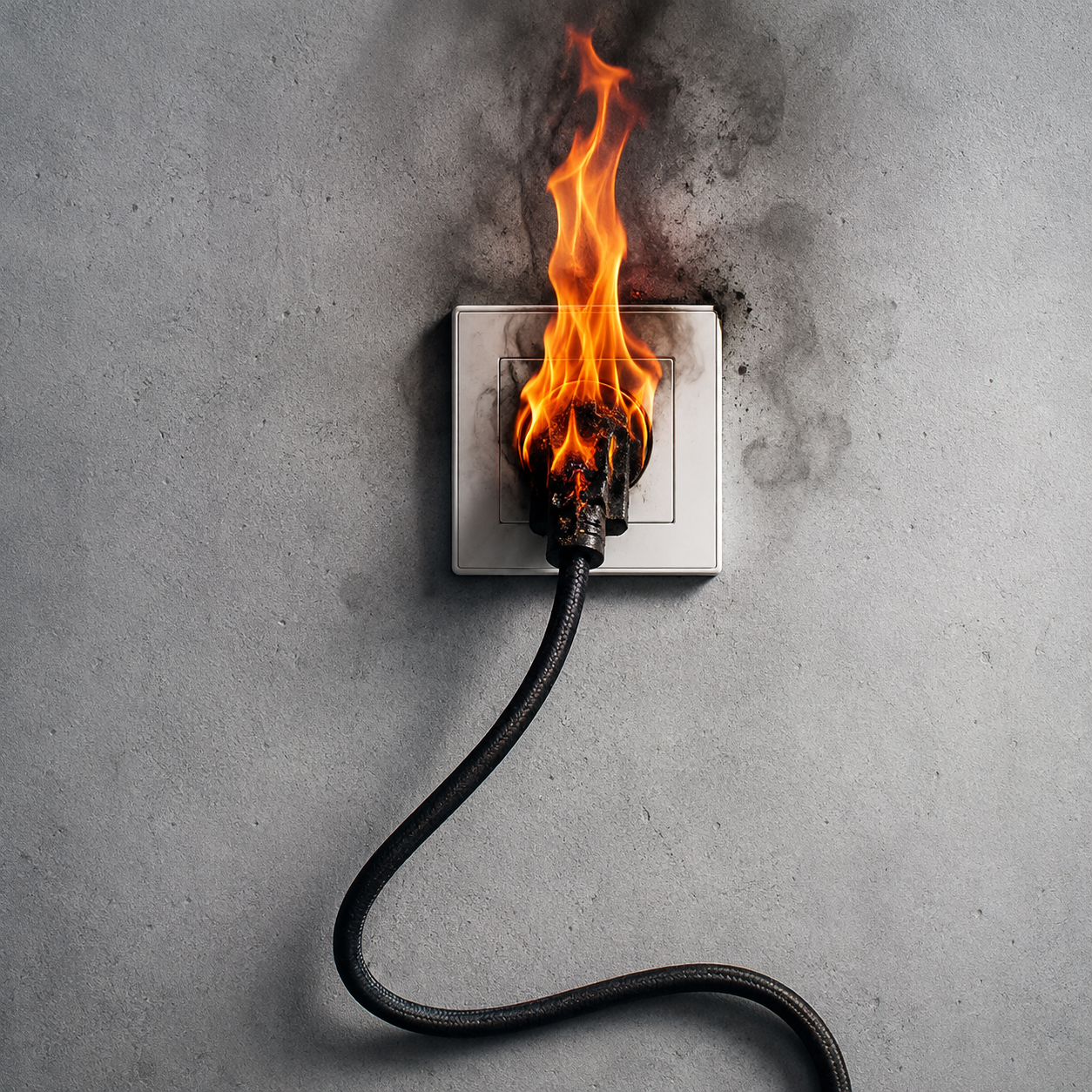
Fire-performance cables with reduced flame spread and heat release, combined with low smoke and acid emissions, make an important contribution to preventing or limiting fires in buildings and to supporting the evacuation and rescue of people and animals.
The European Fire Classes
In the European fire classes Aca to Fca, the fire performance of cables is specified and classified according to flame spread and heat release.
Class Aca (non-combustible), B1ca and B2ca represent very high requirements. The remaining classification levels range from Cca (high), through Dca (medium), to Eca (low). Class Fca (highly flammable) has no specified performance requirements and may not be installed unprotected inside buildings.
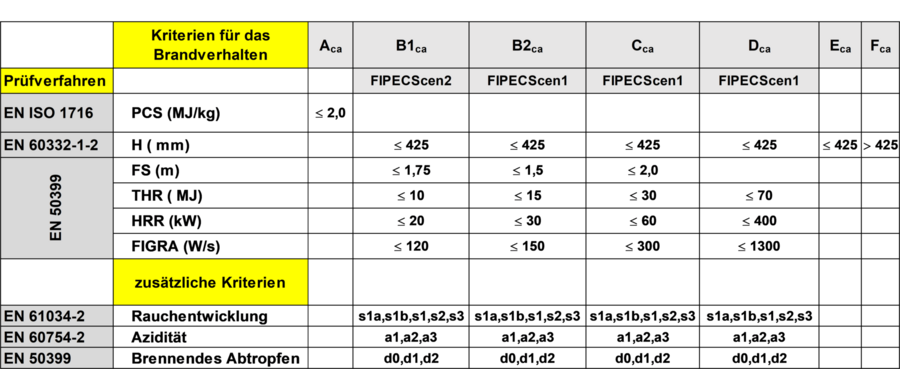
Additional, equally important criteria for fire performance are the specification and classification of smoke development (s), acidity (a) and flaming droplets (d). The corresponding index indicates the level of requirement. The lowest number represents the highest requirement, while the highest number represents the lowest requirement.
The objective is to achieve extremely low smoke development and smoke density in order to enable or facilitate evacuation from the building and rescue operations. Low toxicity of fire gases helps prevent or reduce poisoning, irritation and chemical burns to the respiratory tract. Low corrosivity of fire gases also reduces consequential damage to property and equipment.
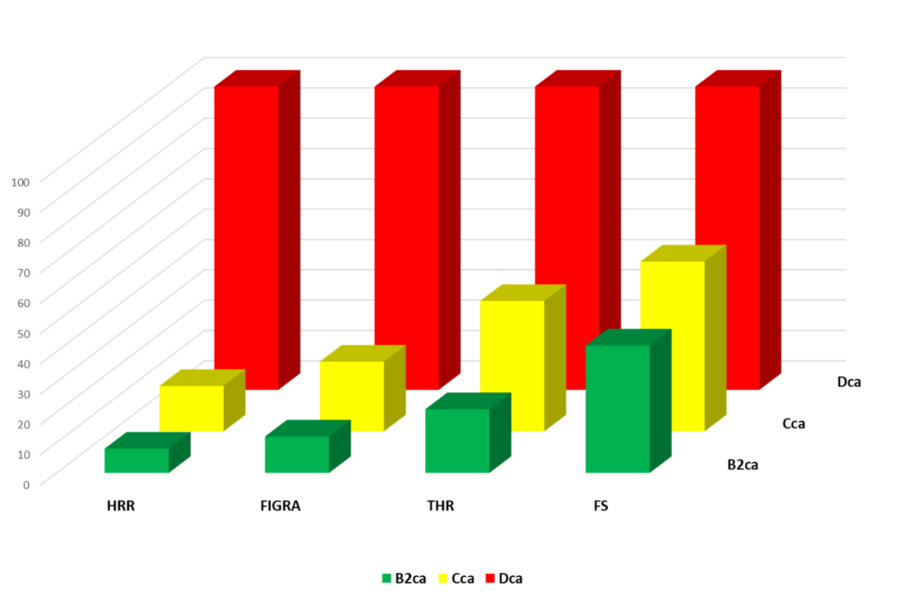
For the practical and effective implementation of preventive fire protection measures, the fire classes B2ca, Cca and Dca have become particularly relevant. Compared with fire class Dca, the fire classes B2ca and Cca provide a higher level of contribution to fire safety.
Declaration of Performance, CE Marking and System of Conformity
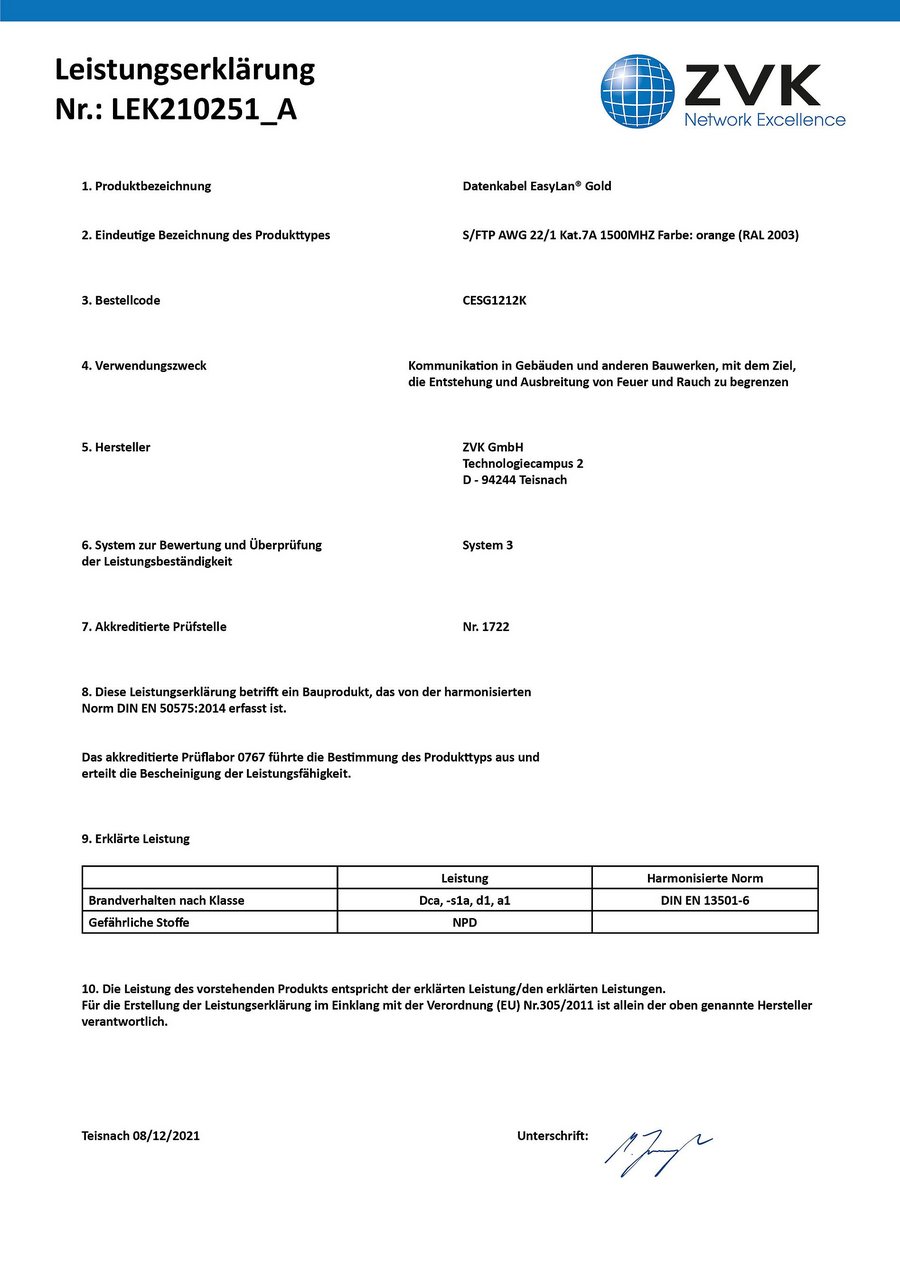
In accordance with the European Construction Products Regulation, the Declaration of Performance contains mandatory and binding information on the fire performance of the cable.
In addition to the declaration of the European fire class together with supplementary criteria such as smoke development, acidity and flaming droplets, it also includes information on the manufacturer, the product identification code, the conformity system and the notified body.
The Declarations of Performance are available on our website.
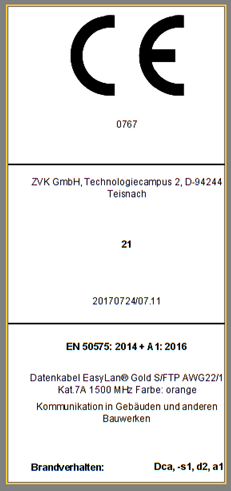
All cables that fall within the scope of the Construction Products Regulation are marked with the CE marking and the declared fire performance before being placed on the European market.
The CE marking and the fire performance information are shown on the product label attached to the cable packaging, reel or drum.
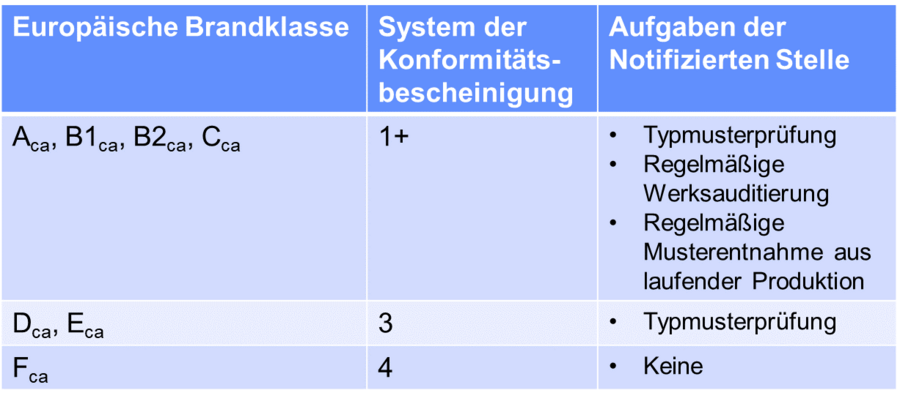
The Declaration of Performance and CE marking are based on certifications or tests carried out by notified bodies, i.e. officially recognised testing institutes. The scope of certification depends on the intended fire class and is governed by the applicable system of conformity assessment.
Buildings with a Very High Risk Level
- Very high number of occupants
- Very long evacuation time
- Very difficult escape routes
e.g.hospitals, care homes and large event venues
Buildings with a Medium Risk Level
- Medium number of occupants
- Medium evacuation time
- Accessible escape routes
e.g.offices, apartment buildings and storage areas
Buildings with a High Risk Level
- High number of occupants
- Long evacuation time
- Difficult escape routes
e.g. administrative buildings, high-rise buildings and hotels
Buildings with a Low Risk Level
- Low number of occupants
- Short evacuation time
- Simple escape routes
e.g. single-family homes and small buildings
Selection of Fire-Performance Cables and Fire Classes Depending on the Safety Requirements of Buildings
Based on national building regulations, cables installed in buildings must comply with at least European fire class Eca. This means that cables installed within buildings must, as a minimum, pass the flame-retardancy test in accordance with EN 60332-1-2.
Taking into account the level of risk within buildings and the resulting safety requirements, the use of Class B2ca cables is recommended for very high safety requirements and Class Cca cables for high safety requirements. For medium safety requirements, the use of Class Dca cables is sufficient.
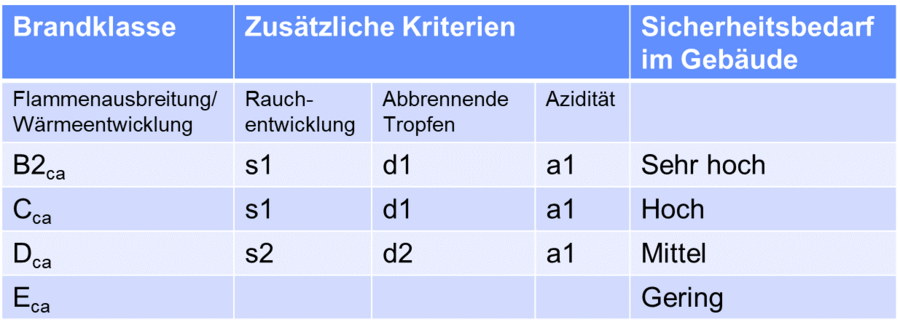
Recommendations for the selection of fire-performance cables depending on the required level of safety within the building. (Source: ZVEI White Paper “Fire-Performance Cables Increase Safety”)
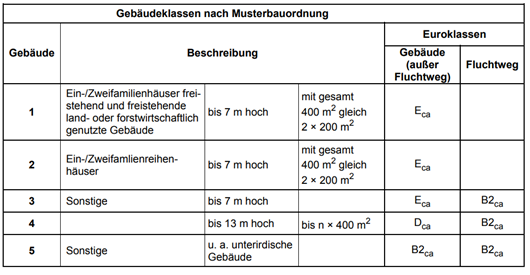
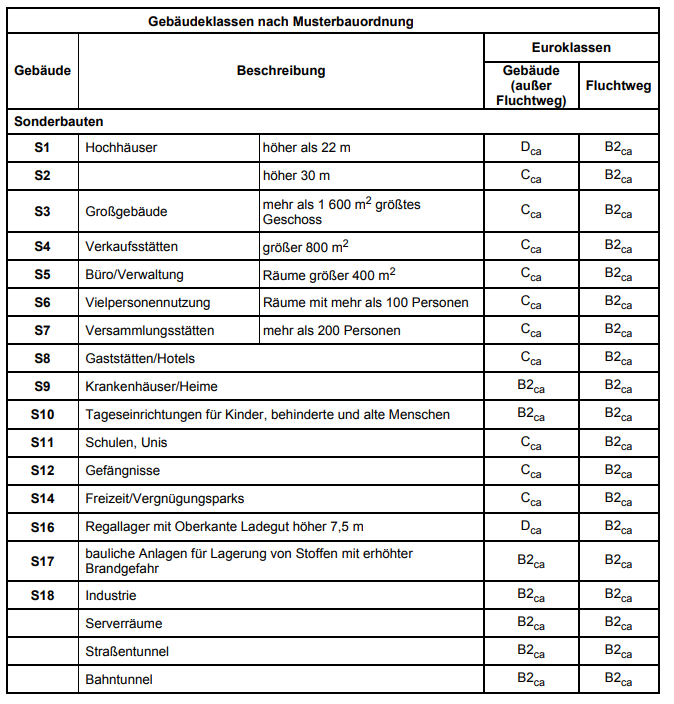
National Annex NA.1 of the European standard for the installation of communication cabling provides more specific recommendations for the use of European fire classes in correlation with the applicable building classification in accordance with the Model Building Code (MBO).
National Recommendation for the Use of Communication Cables with Fire Performance in Accordance with the Construction Products Regulation, Correlated with the Building Classes Defined by the Model Building Code (Source: DIN EN 50174-2)
EasyLan® Product Range
The EasyLan® product range includes copper data cables and fibre-optic cables with reduced flame spread and heat release, combined with low smoke and acid emissions, for use in buildings with medium to very high safety requirements.
Detailed product information and planning documents are available on our website.